Cell free DNA in maternal blood
Selection based on the combined test
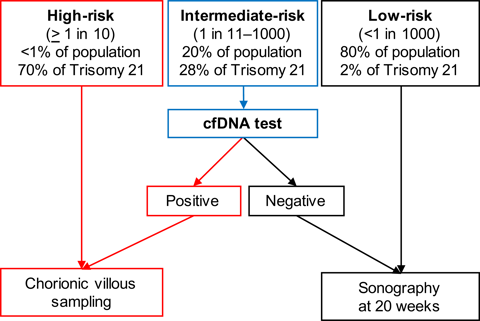
The results of the combined test would stratify the population into:
- A very small group (<1% of the total) at very high-risk for trisomies 21, 18 or 13 (>1 in 10) that would best be managed by invasive testing because this group contains many trisomies and other chromosomal abnormalities.
- A very large group (about 80% of the total) at very low risk (<1 in 1000) that contains very few of the trisomies and may not require any further tests.
- An intermediate-risk group that would have cfDNA testing followed by invasive testing for those with a screen positive result.
The exact risk cut-off that defines the intermediate- and low-risk groups will depend on the cost of cfDNA testing and therefore the proportion of the population that can be offered this test:
- At a risk cut-off of 1 in 100, 5% of the population would have cfDNA testing and 90% of all fetuses with trisomy 21 would be detected.
- At a risk cut-off of 1 in 500, 15% of the population would have cfDNA testing and 95% of all fetuses with trisomy 21 would be detected.
- At a risk cut-off of 1 in 1000, 20% of the population would have cfDNA testing and 98% of all fetuses with trisomy 21 would be detected.