
Twin pregnancies
Chromosomal abnormalities
In twin pregnancies effective screening for chromosomal abnormalities is provided by a combination of maternal age, fetal NT thickness, FHR and maternal serum free ß-hCG and PAPP-A.
In DC twins the detection rate (about 90%) and false positive rate (3% per fetus or 6% per pregnancy) are similar to those in singleton pregnancies. The patient-specific risks for trisomy 21 are different for the two fetuses because of differences in NT.
In MC twins the false-positive rate of screening (8% per pregnancy) is higher than in DC twins, because increased NT in at least one of the fetuses is an early manifestation of TTTS.
- MC twins are monozygotic and they are invariably concordant for fetal karyotype. However, in chromosomally abnormal fetuses there is often discordancy in NT.
- The risk for trisomy 21 is calculated for each fetus and then the average risk between the two fetuses is considered to be the risk for the pregnancy as a whole.
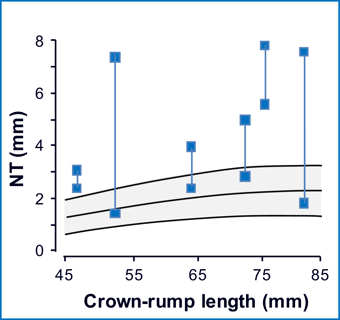
NT in monochorionic twin pairs with trisomy 21 plotted on the normal range