Stratification of pregnancy management
36 weeks’ gestation
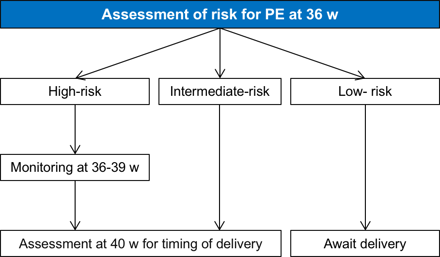
Screening of the whole population by a combination of maternal factors, MAP, PLGF and sFLT-1 can be carried out and on the basis of risks for PE the pregnancies are stratified into different management pathways:
- High-risk group (risk for PE at <40 weeks of ≥1 in 100). This constitutes about 20% of the total and contains >90% of those that develop PE at <40 weeks. These pregnancies require regular monitoring by measurement of blood pressure and urinalysis at 36-39 weeks. Further intensive monitoring may be necessary for those with ultrasound features of fetal growth restriction at the 36 weeks scan and those that develop hypertension.
- Low-risk group (risk for PE at <42 weeks of <1 in 200). This group, which constitutes about 40% of the total, has a >99.9% chance of not developing PE and in the absence of any other obstetric indication could be managed expectantly awaiting for spontaneous onset of labor.
- Intermediate-risk group (risk between the high- and low-risk groups above). This group, together with the high-risk group that remains undelivered by 40 weeks’ gestation, constitutes about 60% of the total and contains almost all cases of PE at >40 weeks. These pregnancies require reassessment at 40 weeks to decide the best time for delivery.