Performance of screening
Screening at 20-24 weeks
The objective of screening for PE at 20-24 weeks’ gestation is to estimate the patient-specific risk of developing PE and on the basis of such risk define the subsequent management of pregnancy, including the timing and content of subsequent visits. This would potentially minimize adverse perinatal events for those that develop PE by determining the appropriate time and place for delivery.
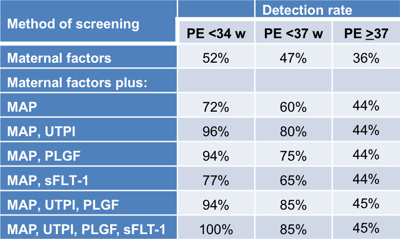
In pregnancies that develop PE the second-trimester values of MAP, UTPI, and sFLT-1 are increased and PLGF is decreased. For all biomarkers the deviation from normal is inversely related to the gestational age at which delivery becomes necessary for maternal and / or fetal indications and therefore, the performance of screening is better for preterm PE than term PE.
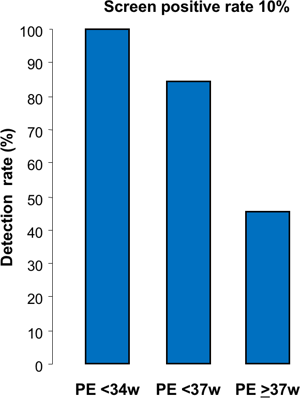
Combined screening by maternal factors, MAP, UTPI, PLGF and sFLT-1 predicts all cases of early PE (<34 weeks), at screen positive rate of 10%. Serum sFLT-1 improves the performance of screening for early-PE but not for PE at ≥34 weeks. Screening by maternal factors, MAP, UTPI and PLGF predicts 85% of preterm PE (<37 weeks) and 45% of term PE (≥37 weeks).