Fetal growth restriction
Timing of delivery
The aim of antenatal suveillance is to decide the optimal time for delivery by balancing the fetal versus neonatal risks
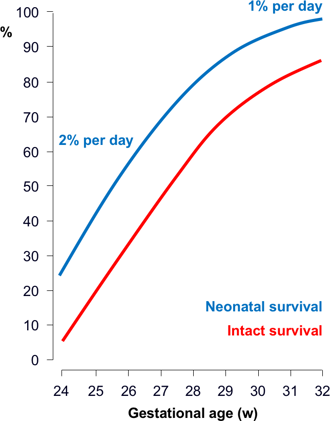
The chance of survival without handicap increases substantially with gestation by about 2% per day between 24 and 28 weeks and by about 1% per day until 32 weeks. Consequently, the threshold for delivery should be inversely related to gestation
After 34 weeks: high pulsatility index (PI) in the umbilical arteries or high PI in the ductus venosus or low PI in the middle cerebral artery or amniotic fluid index below the 5th centile
31-33 weeks: absent end-diastolic flow in the umbilical artery or absent a-wave in the ductus venosus or deepest pocket of amniotic fluid less than 2 cm and no movements
28-30 weeks: reversed a-wave in the ductus venosus or reversed end-diastolic flow in the umbilical artery and deepest pocket of amniotic fluid less than 2 cm and no movements
Less than 28 weeks: reversed a-wave in the ductus venosus and reversed end-diastolic flow in the umbilical artery and deepest pocket of amniotic fluid less than 2 cm and no movements